Tell me your idea
Even if the idea is still vague, we work it out together. Write to me on WhatsApp or by email, I reply within 48h.
Giulia Dal Bon hand-paints murals for local authorities: a school façade, a covered playground, a sports hall, a games court, a town hall entrance, a library, a market hall, a substation, an underpass, a site hoarding. The town of Segrate has already commissioned her for the mural on its bowls club house, painted for the town festival. Itemised quote and invoice in the council’s name, from 150 € per sqm, reply within 48h.
Tell me your idea, and I will be glad to reply.
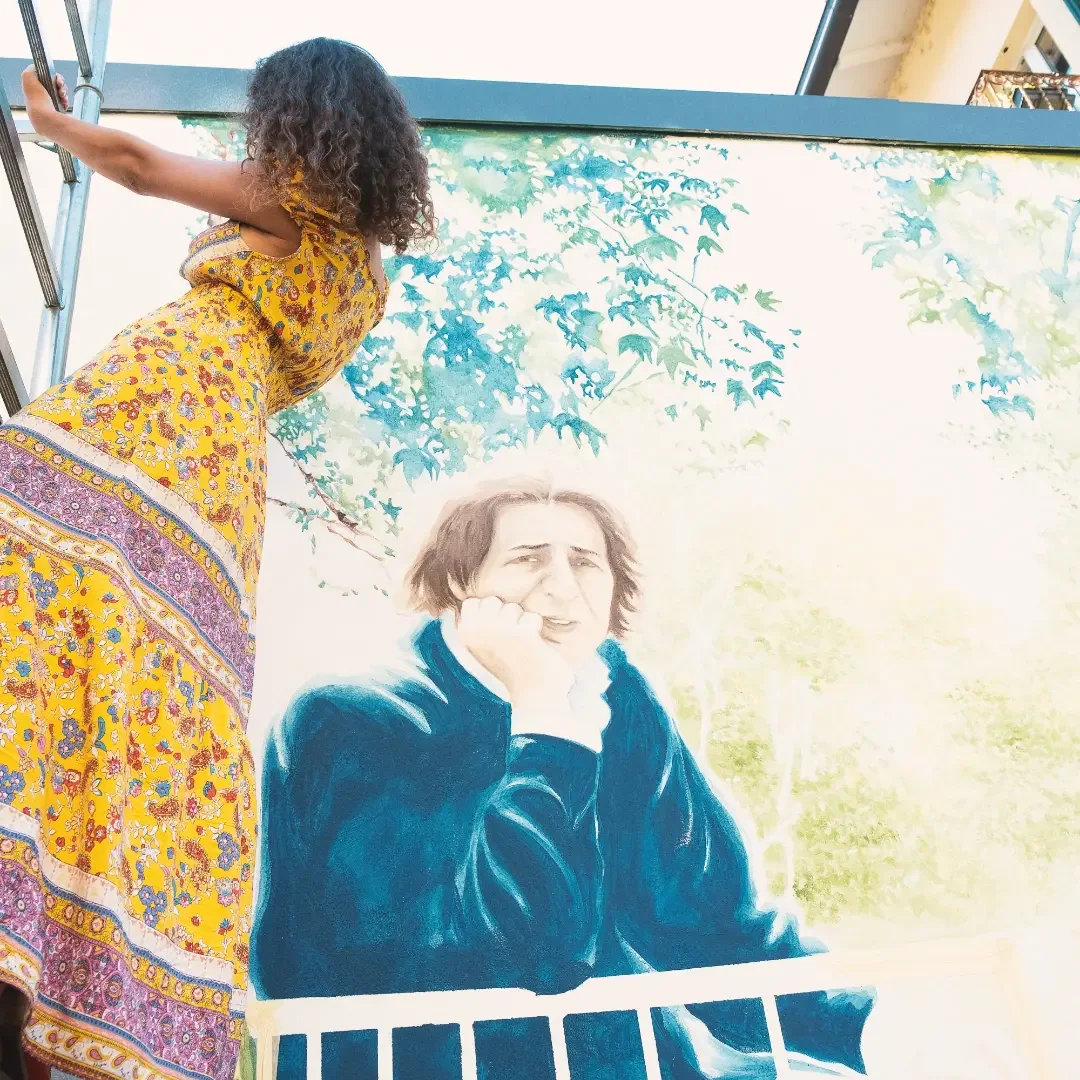
| Simple motif or line drawingFine lines for flowers, patterns, silhouettes or figures… | 150 €/sqm |
|---|---|
| Fully painted subjectColour and shadow for landscapes, portraits or scenes… | 250 €/sqm |
| Trompe-l’oeil or ceilingThe wall opens onto a false window, a painted sky or a whole landscape… | 350 €/sqm |
| Outdoor façade: scaffolding, where needed, is added to the quote. | |
Free quote within 48h
When you write to me about a mural in your town, here is what happens next.
Even if the idea is still vague, we work it out together. Write to me on WhatsApp or by email, I reply within 48h.
Send me a photo of the wall and I draw a sketch straight onto your photo. You tell me what you think. The first two sketches are included.
Once the sketch is approved, I send you the quote and we set the date together.
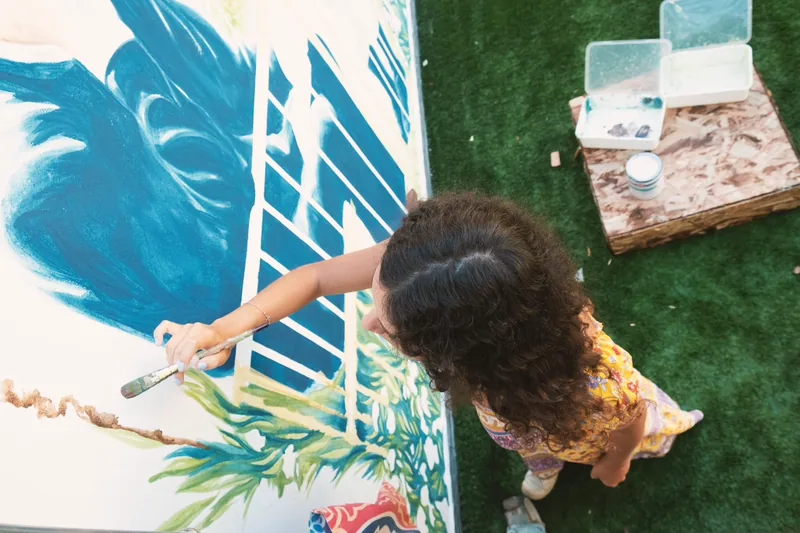
I come and paint in your town, with a brush, and the place stays open while I work.
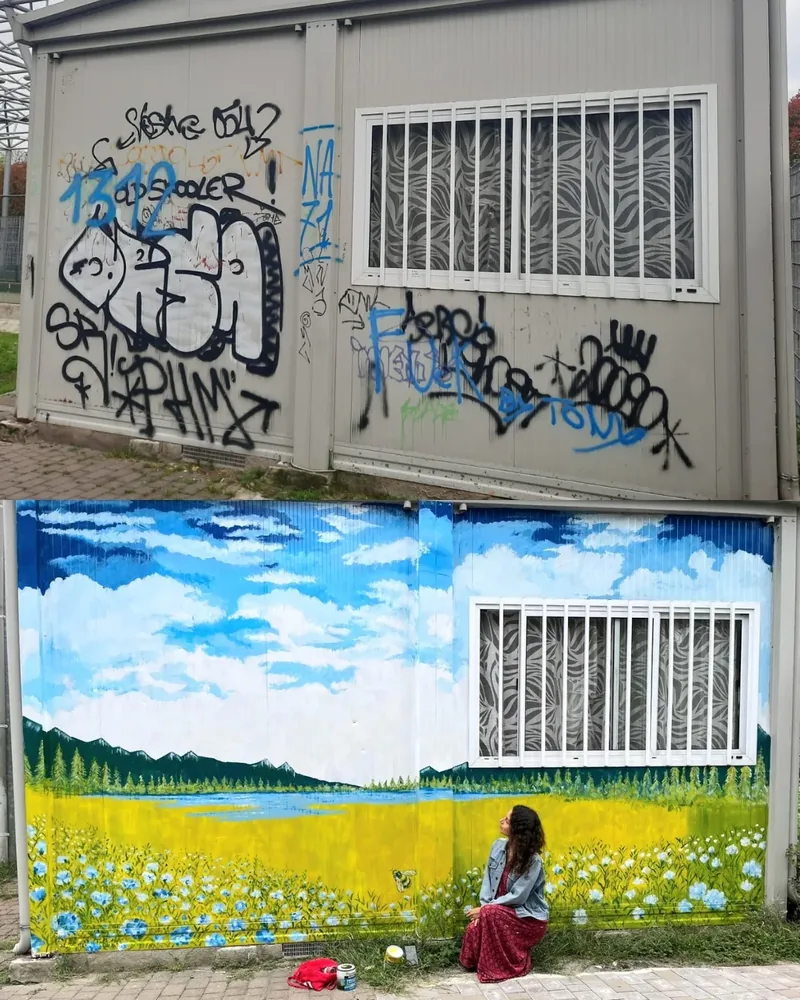
The town of Segrate, in Lombardy, commissioned Giulia Dal Bon for the mural on its bowls club house, painted by hand with the Fermata Giovani Artisti association for the town festival « Io sono Segrate ». The wall carried tags; today it carries a field of flowers, and the council’s own website documents the work. It is a public commission, with an official source.
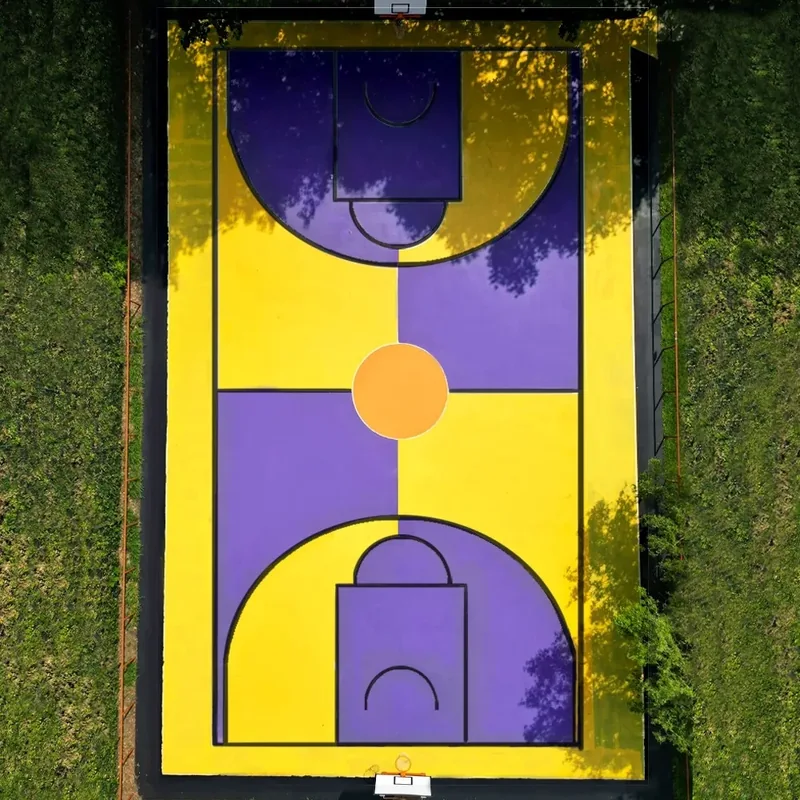
In 2023 the same town had already commissioned the basketball court of Milano Due, opposite the San Raffaele hospital: Giulia redrew its surface in the colours of the Lakers. Two public commissions, in the same town.
In Milan her mural of more than twenty metres dedicated to Giorgio Gaber and Enzo Jannacci stands in public space: Corriere della Sera, La Repubblica and Sky Arte have written about it. Giulia is a painter, trained at the Brera Academy of Fine Arts, where she also studied restoration, and she exhibits her paintings in art galleries.
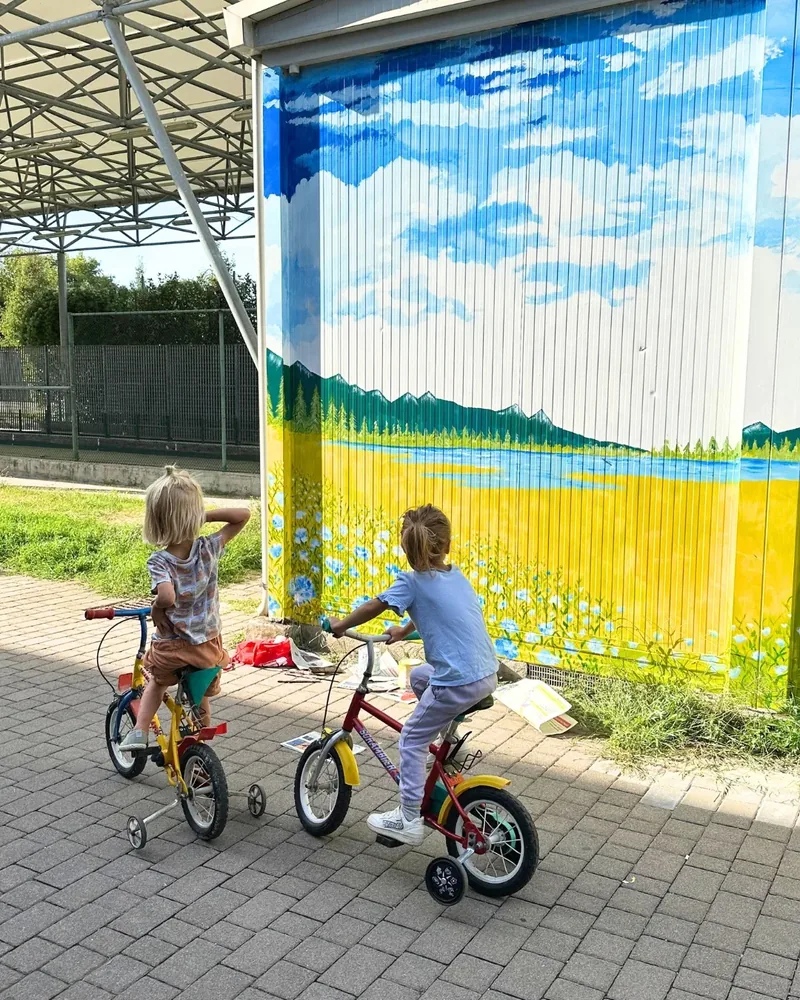
A town owns dozens of walls that can be painted. The walls that lend themselves to it: a school façade and the covered playground, the sports hall, the games court, the town hall entrance, the library, the market hall, the village hall, the community centre, a cemetery wall, an electricity substation, an underpass, a retaining wall, and the hoarding of a site that will stand for months.
The subject comes from the place: a landscape of the town, a local trade, a local festival, a regional product, a figure, a map of the village, a frieze for the children on a school wall. Outside Giulia paints in quartz paint, with an anti-pollution varnish on a façade exposed to traffic and an anti-graffiti varnish on a wall reachable from the street. The protective varnish then allows sponge cleaning: the mural lasts a lifetime.
Work in a public space is a neighbourhood event. People take the time to look, come back to see what has moved on, photograph the wall. For a council that is community life as much as improvement, and the local press takes an interest before the mural is even finished.
Giulia writes an itemised quote (surface, technique, materials, protection, timetable) and an invoice in the council’s name, settled through the usual public payment route. She replies within 48 hours, travels across seventeen countries and speaks four languages.
In France the threshold is worth knowing: below 60,000 € excluding tax, advertising and competitive tendering are optional. A council can therefore commission a mural directly. At 150 € per sqm that ceiling covers around 400 sqm of wall, so almost any town project sits comfortably below it.
The 1 % for art scheme is the other route: since the decree of 18 May 1951, 1 % of the cost of a public building goes to a work conceived for that building, and more than 12,400 projects have been carried out with 4,000 artists. Schools, colleges and libraries are the first to benefit. Giulia is eligible for these calls and answers them gladly.
In France, below 60,000 € excluding tax, advertising and competitive tendering are optional: the council can commission the mural directly. At 150 € per sqm that ceiling covers around 400 sqm of wall, which comfortably covers a school façade, a sports hall or a market hall. Giulia Dal Bon writes an itemised quote and an invoice in the council’s name.
Yes. The town of Segrate, in Lombardy, commissioned her for the mural on its bowls club house, painted by hand with the Fermata Giovani Artisti association for the town festival « Io sono Segrate »: the wall carried tags, today it carries a field of flowers, and the council’s own website documents the work. In Milan her mural of more than twenty metres dedicated to Gaber and Jannacci stands in public space.
Yes. Since the decree of 18 May 1951, 1 % of the cost of a public building goes to a work conceived for that building; more than 12,400 projects have been carried out with 4,000 artists, and schools, colleges and libraries are the first to benefit. Giulia Dal Bon is eligible for these calls and answers them gladly: send her the brief, she replies within 48 hours.
Giulia Dal Bon paints by the square metre: 7,500 € for a line drawing or a simple motif, 12,500 € for a fully painted subject, 17,500 € for a trompe-l’oeil or a ceiling. The price includes the paint and the materials, the first two sketches and the finishing varnish. The quote is free, arrives within 48 hours and itemises every line.
A lifetime. Outside Giulia paints in quartz paint, made for façades. On a façade exposed to traffic she offers an anti-pollution varnish, and on a wall reachable from the street an anti-graffiti varnish that allows cleaning while the paint stays intact. The final protective varnish leaves the wall washable with a damp sponge.
Yes, and that is what gives the mural its place in the neighbourhood. Giulia can have someone lay a colour, add a detail or sign the bottom of the wall, prepare the design with a class, or paint during a town festival in front of the residents. She speaks four languages and works at the pace you set.
Yes, and it is the timetable most councils choose for a school or a sports hall. The dates are set with you when the quote goes out, and the wall is finished for the new term. In term time, odourless acrylic also lets her paint indoors while the building stays in service.
Giulia Dal Bon, a painter trained at the Brera Academy of Fine Arts in Milan, where she also studied restoration. She exhibits her paintings in art galleries and paints murals in seventeen European countries. Corriere della Sera, La Repubblica, Domus and Sky Arte have written about her work, and her mural of more than twenty metres dedicated to Gaber and Jannacci can be seen in Milan. She paints with a brush, layer after layer, and signs the work if you wish.
Indoors, odourless acrylic colour: the place stays open for the whole of the work. Outdoors, quartz paint, made for façades, with anti-salt varnish by the sea and anti-pollution varnish in the city. As a finish Giulia applies a protective varnish: the mural lasts a lifetime, and the wall wipes clean with a damp sponge, leaving the paint intact.
To seventeen countries across Europe, from big cities to small villages. It all starts with a photo of the wall and its measurements: Giulia draws the sketch on top, then comes to paint on site. She speaks Italian, French, English and Spanish. Write her the name of the town and she will tell you how she would go about it; travel costs and logistics are agreed together.