Trompe-l’oeil: a wall that opens
A trompe-l’oeil is a wall that opens: a false window with its view, a lane running away, a sky on the ceiling, a niche painted into the thickness of the wall. Giulia Dal Bon paints it with a brush, by hand, building the perspective from the spot you actually look from. It is the 350 € per sqm level, the one that asks for the most drawing. Two free sketches, free quote within 48h.
Contact Giulia
Tell me your idea, and I will be glad to reply.
The price of a trompe-l’oeil
| Simple motif or line drawingFine lines for flowers, patterns, silhouettes or figures… | 150 €/sqm |
|---|---|
| Fully painted subjectColours and shadows for landscapes, portraits or scenes… | 250 €/sqm |
| Trompe-l'oeil or ceilingThe wall opens onto a false window, a sky on the ceiling or an entire landscape… | 350 €/sqm |
| Exterior facade: if needed, scaffolding is added to the quote. | |
Free quote within 48h
How much does a trompe-l’oeil cost?
From 350 € per sqm, materials included. A false window of 2 sqm therefore comes to about 700 €, a stretch of corridor of 6 sqm to about 2,100 €. The quote is free and arrives within 48h. On a facade, scaffolding is added when needed, and travel is agreed together.
What does the price include?
The paint and the materials, the first two sketches, your comments while she works, and the protective varnish at the end. Giulia shows the work in progress and waits for your agreement at each stage. A deposit for materials is paid on confirmation, the balance at the end.
Who paints the trompe-l’oeil?
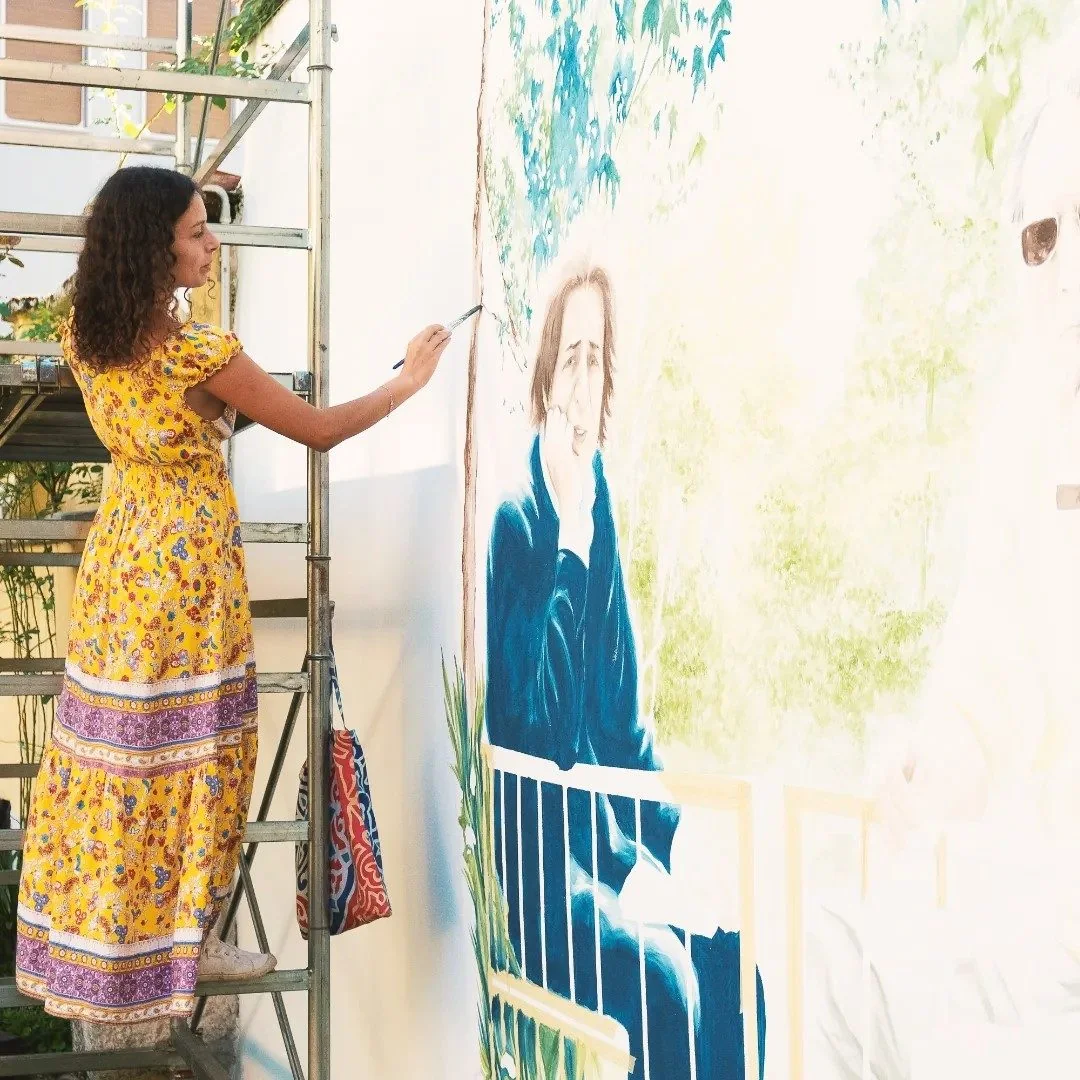
Giulia Dal Bon, a painter trained at the Brera Academy of Fine Arts in Milan, where she also studied restoration. She exhibits her paintings in galleries and paints walls with a brush. She travels in seventeen countries and speaks four languages. Write to her with a photo of the wall: she draws the sketch straight onto it.
What a trompe-l’oeil is
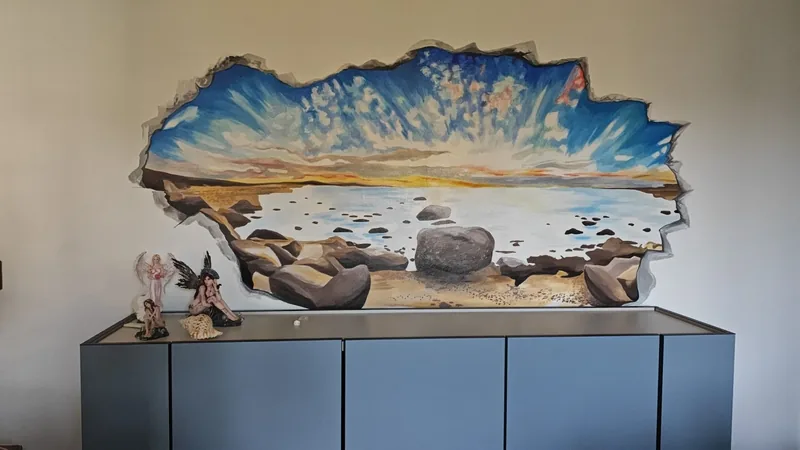
What exactly is a hand-painted trompe-l’oeil?
A painting that makes you believe in an opening or a relief where there is a flat wall. Giulia Dal Bon builds the perspective from the point where you usually stand in the room: the door, the sofa, the end of the corridor. The shadows follow the real light of the room, from the window or the lamp. That alignment is what convinces the eye.
Which subjects work as trompe-l’oeil?
A false window with its view and shutters, a half-open door, a village lane running away, a niche with an object in it, columns, a bookcase, a curtain, a sky on the ceiling. In Liguria facades have been painted this way since the sixteenth century, and at the end of the eighteenth the Republic of Genoa taxed windows: false ones were painted instead, and they are still there.
Does it really make a room feel larger?
A painted opening gives a vanishing point, and therefore depth: the eye travels instead of stopping. That is why it is asked for in corridors, stairwells, small dining rooms and windowless rooms. Giulia shows you the effect on a sketch drawn onto the photo of your wall, before starting.
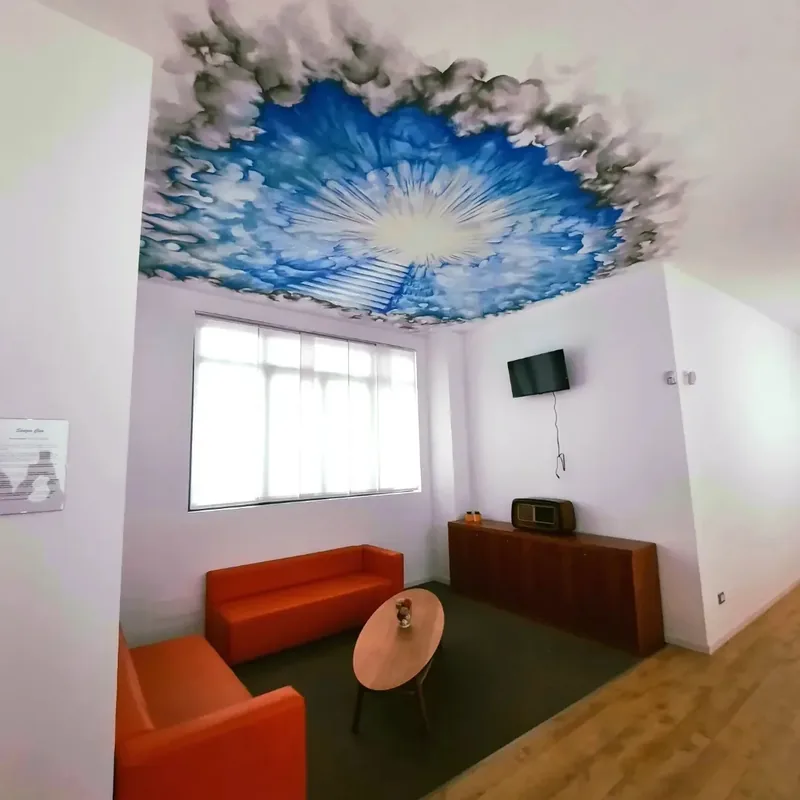
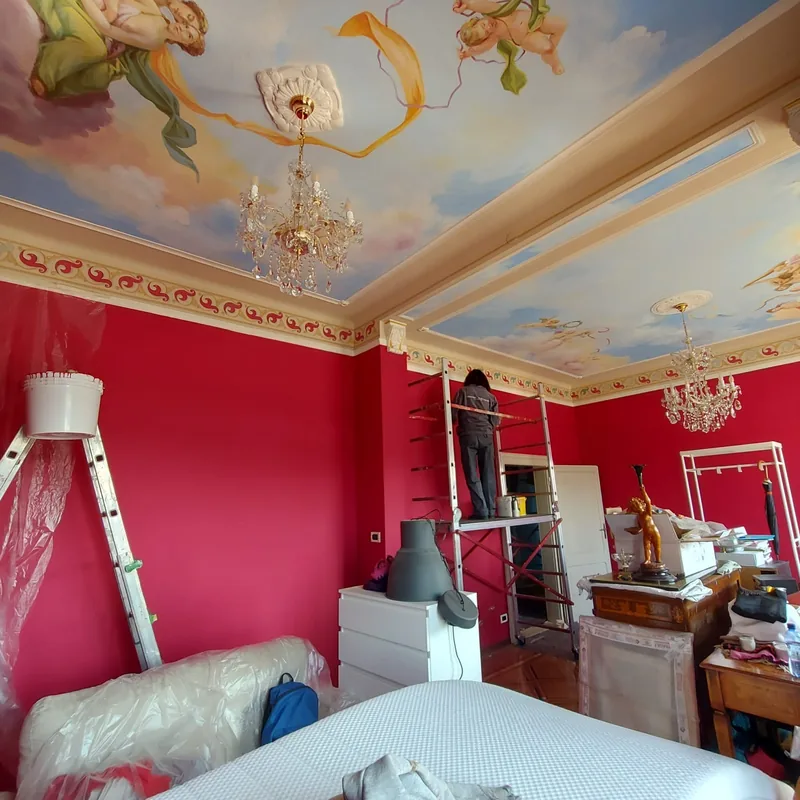
How is a sky painted on a ceiling?
Working overhead, on scaffolding or a ladder depending on the room, with clouds foreshortened so they hold from below. Mantegna opened an oculus at the centre of the vault of the Camera degli Sposi in Mantua between 1465 and 1474; Correggio painted a pergola pierced with ovals in Parma in 1519. A ceiling sits at the same level as trompe-l’oeil, 350 € per sqm.
Where, and on which wall
Where does a trompe-l’oeil work best?
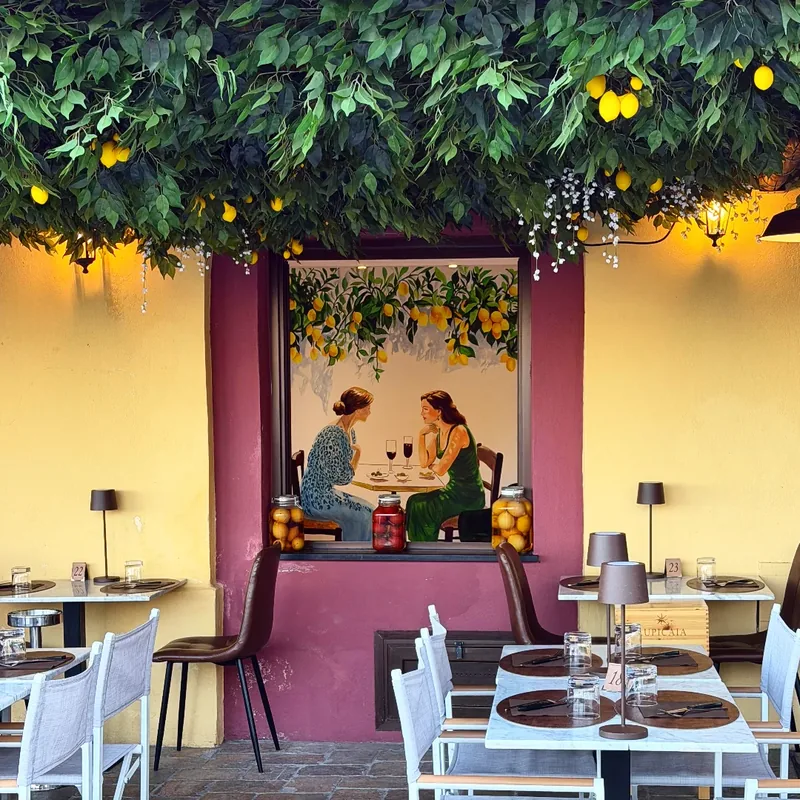
On a blind wall, at the end of a corridor, in a stairwell, above a flight of stairs, in a windowless hall, on a courtyard or garden wall. In a restaurant it carries a whole room; in a shop it becomes the back of the window display. Giulia paints with odourless acrylic indoors, and the place stays open while she works.
Does the wall need to be special?
Ordinary plaster is enough, and Giulia paints over the existing paint after dusting it down. A flat wall serves a trompe-l’oeil, because painted relief reads better on a neutral surface. If there are cracks or damp she says so before the quote and proposes the preparation needed.
Does a trompe-l’oeil last outdoors?
Yes, in quartz paint, made for facades, with anti-salt varnish by the sea or anti-pollution varnish in town. It is the tradition of the painted facades of Liguria and of the Corsican painted ceilings of the nineteenth century. On a facade, scaffolding is added to the quote when it is needed.
Can it start from a photo or a generated image?
Yes. A photograph of a view, a painting you love, an image made with an AI: Giulia takes it as an intention, redraws it at the real size of the wall and in the light of the room, then offers two free sketches. The result is a hand-painted work, drawn for that wall.
Where to start?
What should you send for a quote?
A photo of the wall taken straight on, its approximate dimensions, and the spot people look at it from most often: that point decides the perspective. Add a sentence about the idea, or a reference image. Giulia Dal Bon replies within 48h with a free quote, then two free sketches drawn onto your photo.
How does the work itself go?
Giulia comes and paints on site, protects the floor, and works in odourless acrylic indoors: the room stays in use, the restaurant stays open. She shows the work in progress and adjusts it with you as she goes, then applies the protective varnish at the end. The date is set together, and the duration is written in the quote.