Who to hire to have a wall painted
Mural artist, muralist, wall artist, decorative painter: the same craft goes by several names, and the differences matter when you are choosing. Giulia Dal Bon, a painter trained at the Brera Academy of Fine Arts in Milan, answers 35 questions here. Hand-painted murals from 150 € per m². Free quote within 48 hours.
Contact Giulia
Tell me your idea, and I will be glad to reply.
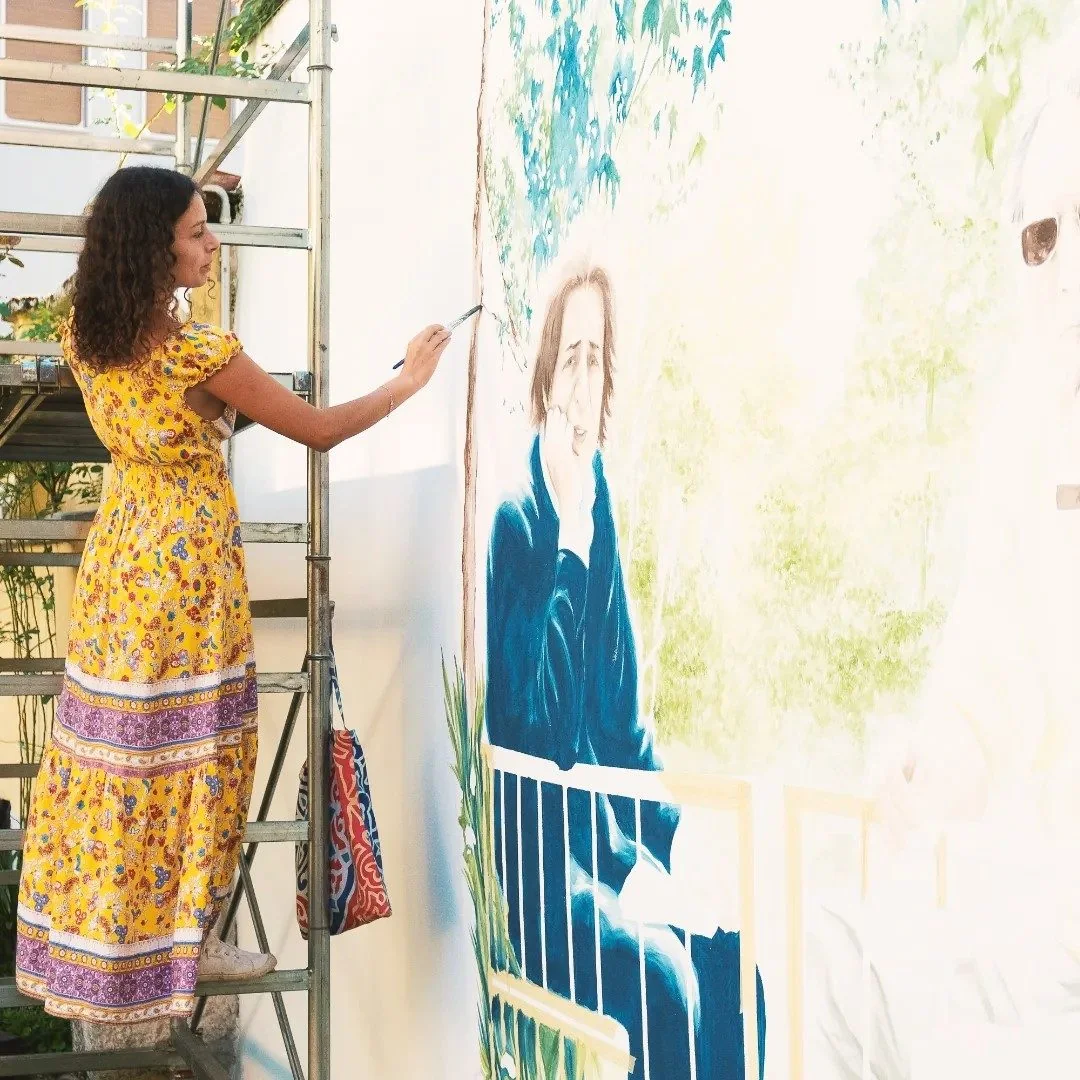
The words for the craft
The same work, several names. Here is what each one means.
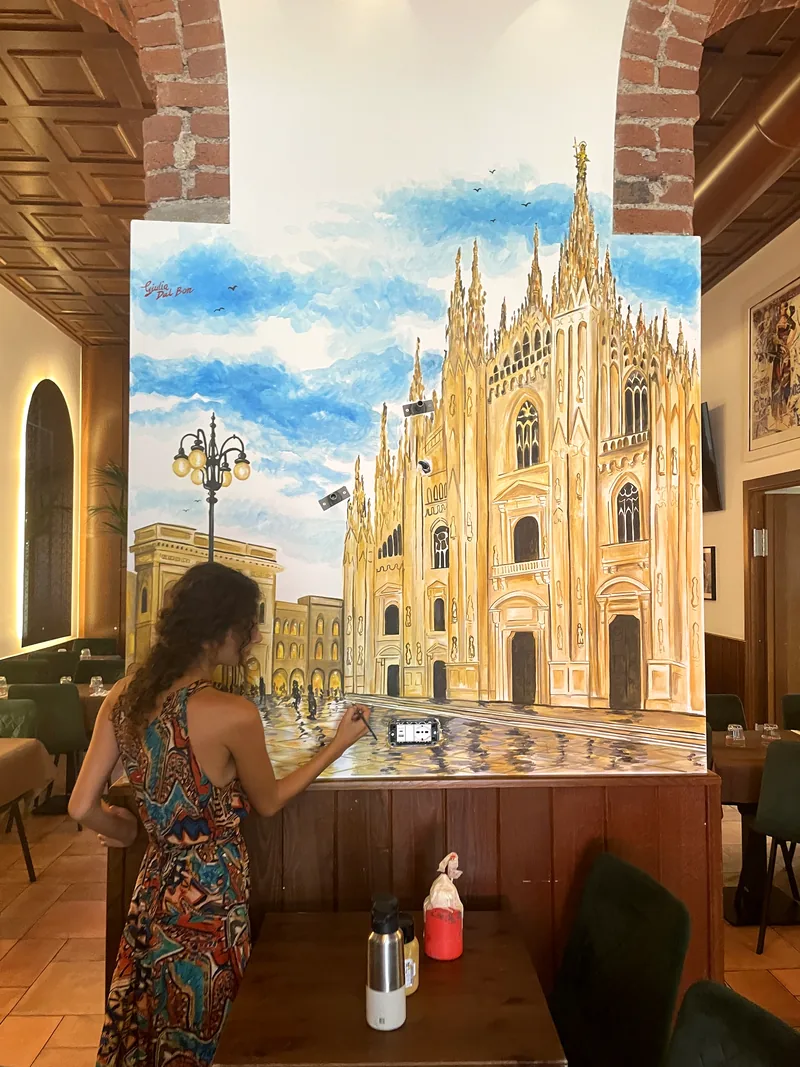
What do you call an artist who paints on walls?
A mural artist, or a muralist. Both words describe the same craft: painting a work directly onto a wall, made for that wall and its size. In Britain you also hear wall artist and decorative painter; scenic artist belongs to theatre and film. Giulia Dal Bon is a painter first, trained at the Brera Academy of Fine Arts in Milan: she exhibits her paintings in art galleries and also paints on walls. Hand-painted, from 150 € per m². Free quote within 48 hours.
What is the art of painting on walls called?
Mural painting, or wall painting. The family covers true fresco, painted onto wet lime plaster, and every later technique painted onto a dry wall: tempera, oil, acrylic, quartz paint. Around 1400 Cennino Cennini wrote Il Libro dell’Arte, the first known technical manual of painting, which set out pigments, brushes and fresco step by step. It is the text that taught Europe how to paint on walls.
What is a painting on a wall called?
A painting made straight onto the wall is called a mural, a wall painting or painted decoration. The word fresco belongs to the old technique, painted on fresh plaster; today most walls are painted in acrylic on the plaster already in place. Giulia Dal Bon, trained at the Brera Academy of Fine Arts in Milan, paints them with a brush, from 150 € per sqm.
What is a painting on a ceiling called?
A painting on a ceiling is called a painted ceiling, or ceiling art. When it opens the room onto a sky or onto architecture, it is a trompe-l’oeil. Giulia Dal Bon paints ceilings by hand, on site, with light scaffolding when the height calls for it. A ceiling follows the trompe-l’oeil rate, 350 € per sqm, and the quote is free, within 48 hours.
What is a mural?
A painting made directly on a wall, drawn for that wall and its exact size. It becomes part of the plaster, runs continuously from edge to edge, and lives as long as the wall. A mural can be figurative, botanical, abstract, a landscape or a trompe l’oeil. Giulia paints hers with a brush, in odourless acrylic indoors and quartz paint outdoors, from 150 € per m².
What is a muralist?
An artist who paints murals: they draw the subject, set it out on the wall and paint it by hand, usually over several days. The craft asks for drawing, colour and a sense of scale, since a motif that reads well on paper behaves differently across eight metres of wall. Giulia works across seventeen European countries: she comes to the place, looks at the wall and paints there.
What does a muralist do?
A muralist draws and paints a work for one precise wall: its size, its corners, the light that reaches it. The drawing is made for that place, the paint is chosen for the surface, and the finish is varnished so the wall can be wiped clean. Giulia Dal Bon works this way indoors and outdoors, from 150 € per sqm, with a free quote within 48 hours.
What is a fresco painter?
A fresco painter works in buon fresco: pigment laid into wet lime plaster, which binds as the lime cures. The painter has to finish each patch within the day, before the plaster sets. Giotto worked that way in the Scrovegni Chapel in Padua between 1303 and 1305, consecrated on 25 March 1305. Today most wall paintings, Giulia’s included, are painted onto a dry wall in acrylic or quartz paint.
What is a decorative painter?
A decorative painter works on ornament: painted panelling, mouldings, borders, faux finishes and trompe l’oeil architecture. The craft sits close to mural painting and often overlaps with it. The difference is one of intent: decorative painting completes a room’s architecture, while a mural is a work in its own right, made to tell your story on that wall.
What is painted wall decoration?
Wall decoration painted by hand covers everything drawn straight onto the plaster: a botanical panel behind a bed, a false window that opens a dark hallway, a sky on a ceiling, a landscape across a living-room wall. The rate is per square metre, 150 € for a line drawing or a simple motif, 250 € for a fully painted subject, 350 € for a trompe l’oeil or a ceiling.
What do you call the drawings on walls in the street?
Street art when it is painted freely in public space, and a commissioned mural when a wall owner, a shop or a local authority orders it. Spray-can lettering is usually called graffiti. A brush-painted mural belongs to a different family: it is built layer by layer and allows gradients, fine detail and trompe l’oeil.
The differences that matter
Fresco, graffiti, wallpaper, sticker: what sets them apart.
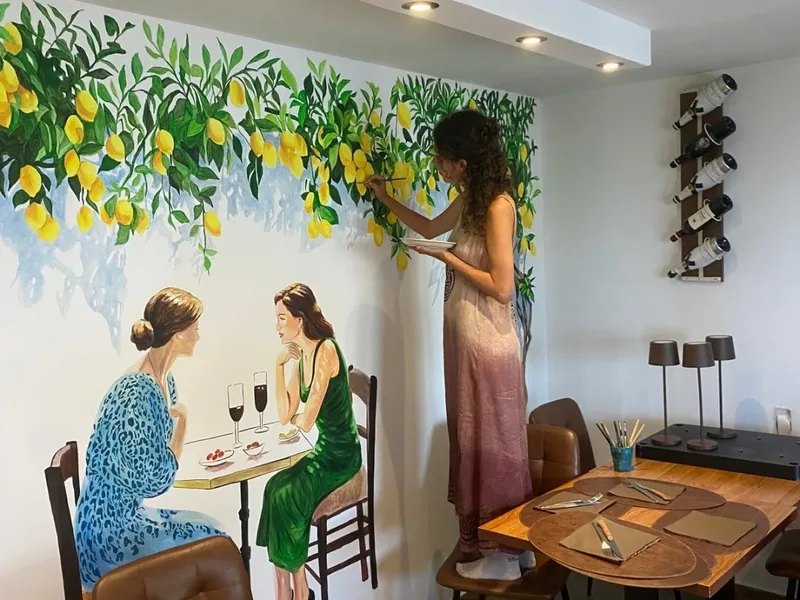
What is the difference between a mural artist and a graffiti artist?
The tool, the gesture and the finish. A graffiti artist works with spray cans: fast, graphic, with a lettering culture behind it. A mural artist works with a brush: the image is built layer by layer, which allows gradients, skin tones, foliage and perspective. Both paint walls, and both do it well; they answer different tastes. Giulia paints with a brush, from 150 € per m².
What is the difference between a mural and a graffiti?
A graffiti is sprayed, often in a lettering tradition, and reads from a distance. A brush-painted mural is drawn first, then painted over several days: it holds detail close up, in gradients and in texture. Think of it as a painting made directly on the wall rather than a canvas hung on it. Both live outdoors when the right varnish protects them.
What is the difference between a mural and a fresco?
A fresco, in the strict sense, is painted into wet lime plaster: the pigment binds as the lime cures, and the painter finishes each patch within the day. Mantegna worked that way in the Camera degli Sposi in Mantua between 1465 and 1474. A mural is painted onto a dry wall, today in acrylic or quartz paint. In everyday English the two words are used loosely for the same thing.
What is the difference between a mural and a trompe l’oeil?
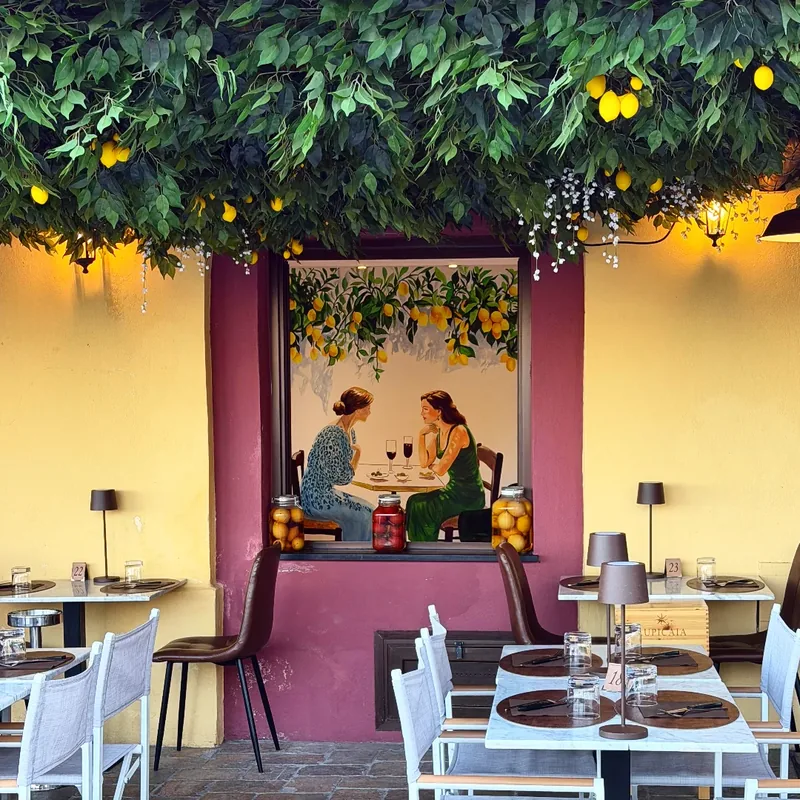
A trompe l’oeil is a kind of mural, painted so the eye reads it as real: a window that opens onto a landscape, a colonnade, a doorway, a bookcase. It asks for exact perspective set to the height of the viewer, which is why it is priced at 350 € per m². The painted facades of Camogli in Liguria are the best-known example: false balconies, cornices and shutters, painted from the sixteenth century onward.
What is the difference between a mural and panoramic wallpaper?
Panoramic wallpaper is printed in fixed widths and hung: it repeats, it shows seams, and it stops where the roll stops. A mural is drawn for your wall and its exact size, runs continuously around corners and switches, and can be painted over later like any wall paint. In budget the two overlap: a high-end panoramic often installs at 100 to 250 € per m², a mural starts at 150 €.
What is the difference between a mural and a wall sticker?
A sticker is printed vinyl that peels off, and costs a few tens of euros. A hand-painted mural becomes part of the plaster, holds its colour for decades and is made to your size and your subject. They answer different needs: a sticker for a season, a mural for the life of the wall.
Should I hire an artist or a painter and decorator?
A painter and decorator covers a surface in a flat colour, often at 25 to 45 € per m². A mural artist draws and paints a subject onto that wall. The two work well together: the decorator prepares and repaints the room, the artist paints the one wall that carries the image. Giulia prepares the surface herself where the wall calls for it, and prices it in the quote.
Can a painter and decorator paint a mural?
Some do, and some are very good at it. The distinction is training: mural painting asks for drawing, colour mixing and scale, which is what an art school teaches. Giulia studied at the Brera Academy of Fine Arts in Milan and exhibits her paintings in galleries. The wall is her favourite canvas because it truly becomes part of a place.
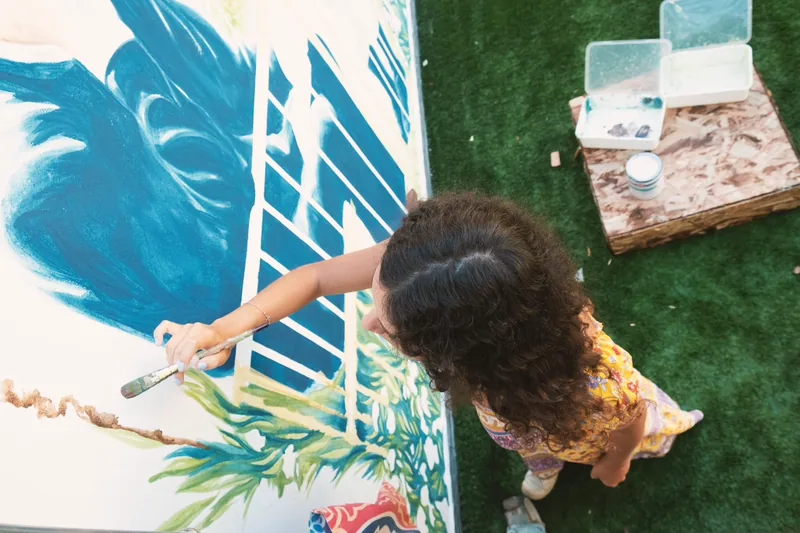
Choosing, and working together
What to ask, how to find the right artist, how far she travels.
How do I get a mural painted on a wall?
Three things start it: a photo of the wall taken square on, its approximate size, and your idea, however loose. From those, Giulia sends a quote within 48 hours with a first drawing set onto the photo of your own wall, to scale. The first two sketches are free, you tell her what you think and she adjusts, and you confirm when you are ready. A deposit of around 100 € covers materials, with the balance settled at the end, together.
How do I find a mural artist?
Look at finished walls rather than mood boards: a portfolio shows whether the artist draws well, handles colour and works at scale. Ask to see a whole wall photographed straight on, and ask what they painted it with. Giulia’s work has been covered by Corriere della Sera, Domus and Sky Arte, and her mural for Gaber and Jannacci, over twenty metres long, can be seen in Milan.
How do I choose a mural artist?
Match the artist to the subject. Someone from a lettering background will give you lettering; someone from painting will give you figures, landscapes, skin tones and depth. Ask for three things: photographs of complete walls, the technique used indoors and outdoors, and a written quote itemising surface, level of detail and timing. Giulia sends hers within 48 hours, and it stays free.
How do I recognise a good mural artist?
Four signs. The portfolio shows whole walls, photographed square on. The drawing holds together at three metres and at thirty centimetres. The artist names the paint and the varnish they use and explains why. And the quote itemises what it covers. Giulia works in odourless acrylic indoors and quartz paint outdoors, with anti-salt varnish by the sea and anti-pollution varnish in town.
What should I ask a mural artist before commissioning?
Ask how many sketches are included and whether revisions are charged for, what paint goes on your kind of wall, how many days on site, what happens to the deposit if plans change, and whether scaffolding is priced separately. With Giulia: two free sketches, then you give your feedback and she adjusts; around 100 € deposit for materials, balance at the end together, scaffolding priced separately above three metres.
How much does it cost to hire a muralist?
Giulia Dal Bon prices by the square metre: 150 € for a line drawing or a simple motif, 250 € for a fully painted subject, 350 € for a trompe-l’oeil or a ceiling. The surface and the technique set the price; scaffolding for a facade and travel are written into the quote, which is free and arrives within 48 hours.
Should the artist be local, or can they come from further away?
A mural is worth the journey: what matters is the drawing on your wall, and that depends on the artist rather than the postcode. Giulia works in France and Italy and travels across Europe to paint, in seventeen countries and more than two hundred cities. Travel and logistics are agreed together and priced in the quote.
Can an artist travel across the whole of France?
Yes. Giulia paints from Menton to Lille and from Strasbourg to Bordeaux, and has pages for Paris, Lyon, Marseille, Bordeaux, Toulon, Nice and the Riviera. In 1951 France wrote wall decoration into law with the one per cent for art scheme: since then more than 12,400 commissions have been commissioned. Painting walls is part of the culture here.
Does Giulia Dal Bon travel abroad?
She works across seventeen European countries: France, Italy, Spain, Switzerland, Monaco, Belgium, the Netherlands, Luxembourg, Germany, Austria, Ireland, Portugal, Denmark, Sweden, Greece, Croatia and the United Kingdom. She speaks Italian, French, English and Spanish fluently. She comes to the place, looks at the wall and paints there. Travel and logistics are agreed together at quoting stage.
Can I bring an Italian artist to paint in England or France?
Yes, and it is what Giulia does most weeks. She is Milanese, trained at Brera, and works from one city to the next across Europe. The practical side is simple: photographs and measurements first, then the quote within 48 hours, then dates. Travel and accommodation are agreed together and written into the quote before you confirm.
Does the artist sign the mural?
Giulia signs the mural if you wish. Some people want the signature visible in a corner, others prefer the wall to carry the image alone. Either way the work stays hers as its author, and yours as its owner. A signed wall is also easier to attribute later, when a photograph of it travels further than the room it was painted in.
Can I photograph and publish my mural?
Yes, and it is welcome. Naming Giulia as the artist is the courtesy that goes with it. While Giulia paints, people take the time to watch, admire and photograph the work in progress as much as the result, and the place gets talked about before the mural is even finished.
Who do I contact for an artistic painting on a wall?
Giulia Dal Bon, a painter trained at the Brera Academy of Fine Arts in Milan. She paints murals, portraits on canvas and landscapes, and exhibits her paintings in art galleries. Send a photo of the wall, its approximate size and your idea: the quote arrives within 48 hours, free, with a first drawing set onto the photo of your wall.
Who do I contact for painted decor in a shop or restaurant?
The same artist, with two practical points in your favour. The paint is an odourless acrylic, so service continues while she works. And the work in progress draws people in: they take the time to watch, admire and photograph, which makes the place talked about before the mural is finished. From 150 € per m², free quote within 48 hours.
Who do I contact for a mural in a school or a public building?
Giulia works with schools, nurseries and local authorities. In France the one per cent for art scheme, created by decree on 18 May 1951 and extended to local authorities after the decentralisation laws of 1983, sets aside one per cent of a public building’s budget for an integrated artwork. More than 12,400 commissions and 4,000 artists have come from it.
Can an interior designer or architect work with the artist?
Yes, and many do. Giulia works from a designer’s drawings, samples and palette, and paints to the scheme rather than beside it. Designers usually document the work in progress, since a wall being painted photographs well and gives the mural a story. The quote itemises surface, level of detail and timing so it drops straight into a schedule.
Find a mural artist, city by city
The other guides
Prices: every answer · Who to hire · Where to paint · Paint and durability · Commissioning · What subject to choose · A Milan restaurant, step by step
Cities
Paris · Milan · Monaco · Barcelona · Rome · Florence · Murals across Europe · All cities
By type of place
Homes and villas · Children’s rooms · Restaurants and cafés · Hotels and boutiques · Facades and exteriors · Ceilings and staircases · Offices and showrooms