What subject to choose for a mural
Botanical, landscape, trompe l’oeil, false window, portrait, lettering, map: the subject decides the mood of the room and the rate per square metre. Giulia Dal Bon answers 39 questions here, room by room, with prices. The first two sketches are free, you tell her what you think and she adjusts. From 150 € per m².
Contact Giulia
Tell me your idea, and I will be glad to reply.
The great families
The subjects that come back most often, and what they cost.
What subject works best for a mural?
The one that suits the room and the light in it. Botanical and floral motifs sit at 150 € per m². Landscapes and figurative subjects come next, at 250 €. Trompe l’oeil, false windows and ceilings sit at 350 €, since the perspective has to be set out exactly. The first two sketches are free, you tell her what you think and she adjusts.
What is a botanical mural?
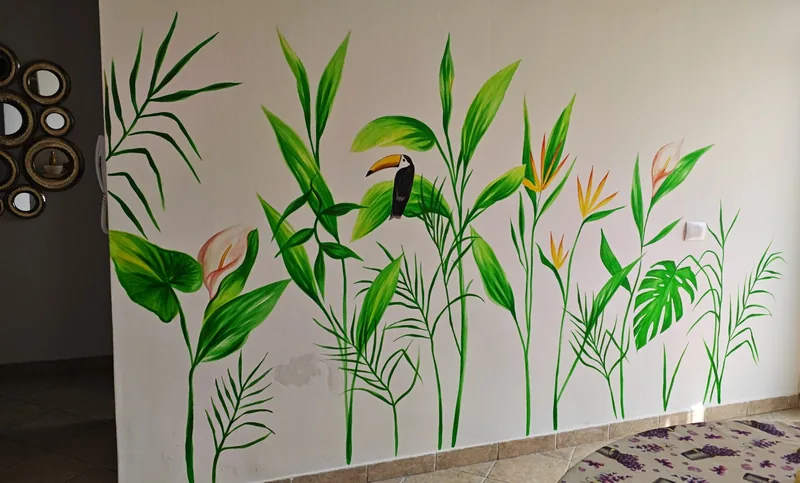
Foliage, branches, leaves, grasses and flowers, drawn at the scale of the wall (the page on flower and botanical murals shows examples): a few large stems behind a bed, or a dense wall of greenery in a hallway. It is the family that sits well with almost any furniture and reads calmly. At 150 € per m², a 6 m² bedroom wall comes to around 900 €.
What is a floral mural?
Flowers as the subject rather than as a border: peonies, magnolia, wisteria, olive branches, wild grasses. Painted large, a single stem across two metres reads as a composition rather than as decoration. It suits bedrooms, hallways, salons and restaurant walls. From 150 € per m², with two free sketches to settle the palette.
What is a landscape mural?
A view painted onto the wall: a valley, a coastline, a forest, a city seen from a hill. It gives a room a horizon, which is why it works in interiors with little natural light. Priced at 250 € per m² as a fully painted subject, so a 12 m² living-room wall comes to around 3,000 €.
What is a trompe l’oeil?
A painting made so the eye reads it as real: a window that opens onto a view, a doorway, a colonnade, a bookcase, a niche. It asks for perspective set to the height of the viewer, which is why it is priced at 350 € per m². The painted facades of Camogli in Liguria, with their false balconies and shutters, are the best-known example in Europe.
What is a false window?
A window painted onto a blind wall, with a frame, a sill, light falling from it and a view beyond. It is the single most effective subject in a dark room: a hallway, a basement, a bathroom, an inner bedroom. Priced at 350 € per m² as a trompe l’oeil. In late eighteenth-century Liguria, when Genoa taxed windows, people painted the ones they went without.
Can you paint a portrait on a wall?
Yes, and Giulia paints portraits on canvas as well: it is her own training. On a wall a portrait asks for precise drawing at scale, so it is priced at 250 to 350 € per m² depending on the size and the treatment. It suits a family home, a restaurant honouring its founder, or a company’s reception wall.
Can you paint an animal on a wall?
Yes, and animals work very well in children's rooms and in restaurants. A single large animal reads better than a crowd: a horse, a whale, a heron, a fox, a tiger. Priced at 250 € per m² as a fully painted subject. A 6 m² wall comes to around 1,500 €.
What is a lettering mural?
Words painted at the scale of the wall: a name, a motto, a menu, a shop sign, a line from a song. It reads from a distance, which makes it work for shop fronts, gyms, offices and roller shutters. Priced from 150 € per m² depending on how worked the letterforms are.
Can you paint a map on a wall?
Yes: a world map, a city plan, a coastline, a constellation chart. Maps suit children’s rooms, studies, hotel lobbies and travel companies, and they hold attention because people look for the places they know. Priced at 250 € per m² as a fully painted subject.
Can a mural be black and white?
Yes, and it is often the strongest choice in a room that already has colour in the furniture. Charcoal, ink and grisaille give depth while the colours already in the room keep their place. Priced by the level of detail like any subject, from 150 € per m². Two free sketches settle the balance of tone.
Can a mural be abstract?
Yes: colour fields, gradients, geometric compositions, gestural forms. Abstract works well in offices, gyms, hotels and modern interiors, and it scales to very large walls comfortably. From 150 € per m² for a simple composition, 250 € where the forms are worked and layered.
Can a mural copy a famous painting?
Giulia paints in the spirit of a work rather than copying it: a Klimt palette, a Hokusai wave, a Matisse cut-out feeling, drawn fresh for your wall and its size. That way the wall carries something of its own. The first two sketches are free, you tell her what you think and she adjusts.
Room by room
Which subject suits which space.
What are good mural ideas for a living room?
Landscapes, botanical walls and trompe l’oeil windows are the ideas that hold a living room. The room is looked at while seated, so Giulia Dal Bon sets the horizon line at seated eye level, which changes how the whole room reads. At 250 € per m² for a landscape, a 12 m² wall comes to around 3,000 €; a trompe l’oeil at 350 € comes to around 4,200 €.
What are good mural ideas for a bedroom?
Calm ideas that read well on waking: a botanical panel, a soft landscape, a dawn sky, a few large stems behind the bed. Strong contrast belongs in the rooms where you spend the day. At 150 € per m², a 6 to 10 m² wall comes to 900 to 1,500 €. Giulia Dal Bon draws the first two sketches free, straight onto the photo of your wall, and you tell her what to change.
What are good nursery mural ideas?
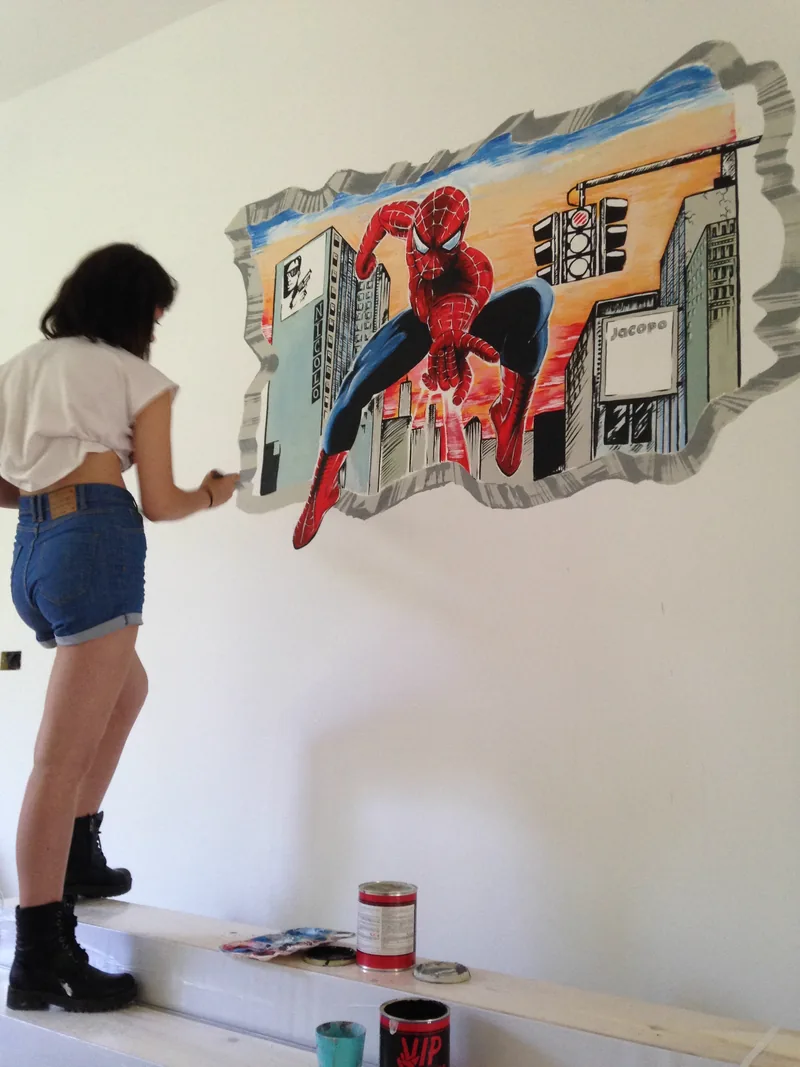
Hand-painted ideas that keep working as the child grows: a forest, a mountain range, a sky with birds, an underwater scene, a botanical panel, a map. Characters from a film date faster than landscapes do. Giulia Dal Bon paints children’s rooms in odourless acrylic, so the room stays in use while she works. At 150 € per m², a 6 to 8 m² wall comes to 900 to 1,200 €.
What are good mural ideas for a kids’ room?
For a child who already has tastes of their own: a jungle with one large animal, a football pitch, a night sky with planets, a castle, a world map, a name painted in letters. Giulia Dal Bon draws the idea with the child and puts it on the photo of the wall, so you both see it before she paints. The first two sketches are free. From 150 € per m².
What subject works in a kitchen?
A market scene, a lemon or olive grove, a botanical panel, a trompe l’oeil window over the sink. Kitchens carry a lot of visual noise already, so one wall with a clear subject works better than four busy ones. Giulia varnishes the areas near the hob and the sink so they wipe clean. From 150 € per m².
What subject works in a bathroom?
Water, foliage, a tropical panel, a seascape, or a false window that opens the room. Bathrooms are often the smallest and darkest room in a house, which is exactly where a painted opening earns its place. Sealed with a suitable varnish. A 4 to 6 m² wall comes to 600 to 900 €.
What subject works in a hallway?
A perspective that lengthens the passage: a colonnade, a garden path, an avenue of trees, a run of false windows. A hallway is walked through rather than looked at, so the subject has to work in motion. At 350 € per m² for a trompe l’oeil, a 6 m² hallway comes to around 2,100 €.
What subject works in a stairwell?
Something that rises with the stairs: a tree that climbs, a wisteria falling down the wall, a sky at the top, a cliff, a waterfall. The eye travels upward on a staircase, so the composition is built for that. At 250 € per m², 8 to 20 m² comes to 2,000 to 5,000 €.
What subject works on a ceiling?
A sky above all: daylight with clouds, a dawn, or a night sky with constellations over a bed. A painted pergola or a coffered trompe l’oeil also works. Correggio painted a pergola pierced with ovals on the vault of the Camera di San Paolo in Parma, between February and September 1519. Priced at 350 € per m².
What subject works in a restaurant?
Something drawn from the cooking and the place: a coastline for a fish restaurant, a market for a bistro, a Neapolitan street for a pizzeria, a vineyard for a wine bar. A wall that tells the restaurant’s own story is photographed by guests far more than a generic one. At 250 € per m², a 15 m² wall comes to around 3,750 €.
What subject works in a hotel?
In rooms, calm subjects that suit sleep: botanical panels, soft landscapes, skies. In lobbies and stairwells, something with more presence that photographs well, since that is the image guests share. The hotel stays open while she works, room by room, thanks to the odourless acrylic.
What subject works in a shop?
Something the brand can stand behind and reuse: a subject drawn from what it sells, its materials, its origin, its story. It becomes a backdrop for product photographs as well as a wall. At 150 to 250 € per m², a 10 m² wall comes to 1,500 to 2,500 €.
What subject works in an office?
Landscapes, abstract colour fields and subjects drawn from the company’s own story work better than an enlarged logo, which people stop seeing after a week. Meeting rooms, reception and the break area are the usual walls. A 12 m² wall comes to around 1,800 to 3,000 €, painted outside working hours.
What subject works on a facade?
Something that reads from across the street and holds up close: a large botanical composition, a figure, a landscape, a graphic scheme. In a protected area the heritage service gives an opinion on the palette. From 150 € per m² in quartz paint, with scaffolding priced separately.
What are good mural ideas for an outside wall?
A view that carries the garden further: a landscape beyond the wall, a trompe l’oeil gate opening onto a path, a climbing plant painted where a real one struggles. Giulia Dal Bon paints outside walls in quartz paint, with an anti-salt varnish by the sea and a protective varnish to finish. Twenty square metres with a simple motif comes to around 3,000 €.
What subject works around a pool?
Water, sky, a Mediterranean coastline, a botanical wall, a trompe l’oeil arch. The wall around a pool is the view from the water, which makes it one of the most rewarding surfaces on a property. Quartz paint with an anti-salt varnish by the sea. A 15 m² wall comes to around 2,250 €.
Choosing, and settling the idea
How the subject gets decided, and what it changes in the price.
How do I choose the subject?
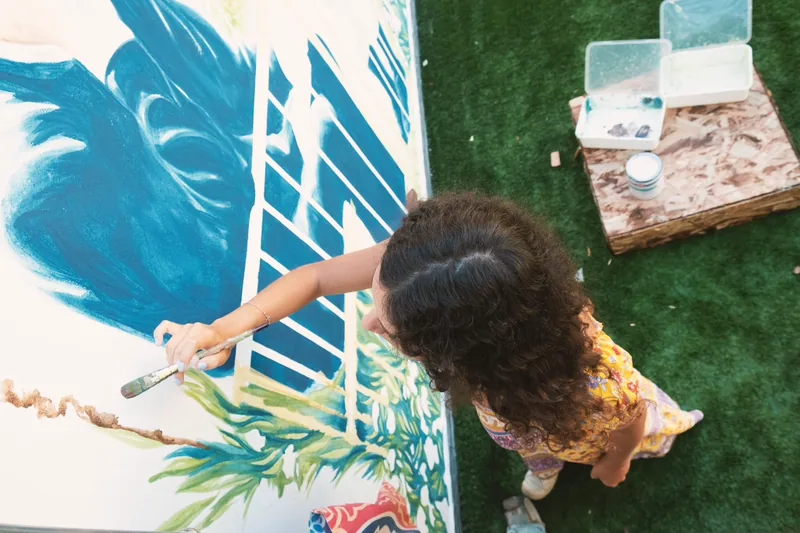
Start from the room rather than from images: how the light falls, where you sit, what you look at from the doorway. Send a photo of the wall and a few things you like, from anywhere. Giulia draws two free sketches onto the photo of your own wall, to scale, and the subject settles from seeing it in place. Revisions are included.
What is a custom wall mural?
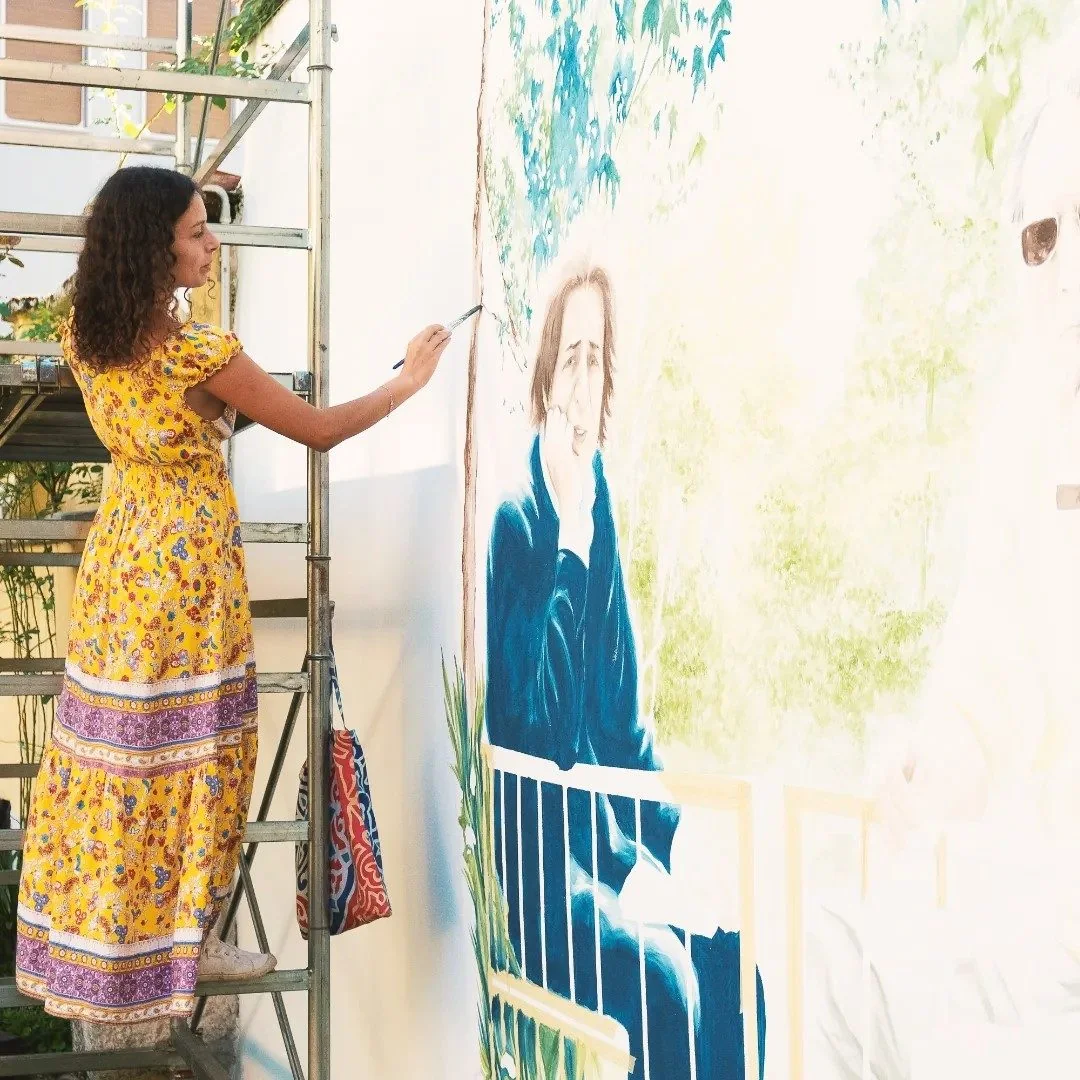
A custom wall mural is drawn for your wall, at its exact size, with the subject and the palette you choose. Giulia Dal Bon starts from your idea and a photo of the wall, draws the sketch straight onto that photo, then paints it by hand on site, so the drawing follows the doors, the sockets and the corners of your room. The first two sketches are free and the quote arrives within 48 hours. Prices start at 150 € per m².
Does the subject change the price?
Yes, and it is the main thing that does. A simple floral or botanical motif is 150 € per m². A detailed or figurative subject, a landscape, an animal, a portrait, is 250 €. A trompe l’oeil, a false window, a ceiling or a large composition is 350 €, because the perspective has to be set out exactly and the painting takes days longer.
Can I bring my own image or drawing?
Yes, and it is a good starting point: a photograph of a place you love, a child’s drawing, a fabric, a family picture. Giulia works from it and draws it for your wall and its size rather than reproducing it flat.
Can the mural be personal to us?
That is the usual case. A view from a family house, the coastline where you met, a garden that has gone, the shape of a boat, a name in the foliage. A wall drawn from something specific holds attention longer than a generic one, and it is what makes the work unique to that place.
How much of the wall should be painted?
One wall painted fully usually reads better than four walls part-painted. Where the budget calls for it, a strong partial works well: a headboard panel, a door surround, the upper third of a hallway, a single corner. Since the rate is per square metre, the surface you choose sets the budget directly.
Should the mural match the furniture?
It should sit with the room rather than repeat it. Giulia takes the palette from what stays in the room, the floor, the large pieces, the light, and builds the subject to sit alongside them. The two free sketches are drawn onto the photo of your actual room, so you see it in place before anything is painted.
Can the subject be changed later?
Yes. An acrylic mural is primed out with an opaque base and repainted, which takes a day or so more than a fresh wall. It is one of the practical advantages of paint over a fixed panel. Where you simply want it gone, two coats of ordinary wall paint cover it.
Can several walls carry one subject?
Yes, and a subject that runs around a corner is one of the things a painted wall does that a printed panel struggles with: it continues across the join, over switches and around obstacles. It is quoted by the total surface, so two walls of 6 m² are priced like one of 12 m².
What subjects does Giulia paint?
Botanical and floral walls, landscapes, trompe l’oeil windows, portraits and skies. She is a painter first, trained at the Brera Academy of Fine Arts in Milan, and exhibits her paintings in art galleries. Her mural for Gaber and Jannacci, over twenty metres long, can be seen in Milan, and her work has been covered by Corriere della Sera, Domus and Sky Arte.
Subjects, places and cities
The other guides
Prices: every answer · Who to hire · Where to paint · Paint and durability · Commissioning · What subject to choose
By type of place
Homes and villas · Children’s rooms · Restaurants and cafés · Hotels and boutiques · Facades and exteriors · Ceilings and staircases · Offices and showrooms
Cities
Paris · Milan · Monaco · Barcelona · Rome · Florence · Murals across Europe · All cities