Which paint, which wall, how long it lasts
Indoors Giulia Dal Bon paints in odourless acrylic, so the room stays usable while she works. Outdoors she uses quartz paint, made for exposed walls, with an anti-salt varnish by the sea or anti-pollution varnish in town. Here are 41 answers on paint, surfaces and how long a mural lasts. Free quote within 48 hours.
Contact Giulia
Tell me your idea, and I will be glad to reply.
In this guide
The paints
What goes on the wall, and why.
What paint is used for a mural?
Indoors, an odourless acrylic: it binds to the plaster, holds its colour and lets the room stay in use while the work goes on. Outdoors, quartz paint, formulated for exposed walls and close in behaviour to acrylic. A varnish is added on top where the exposure calls for it: anti-salt by the sea, anti-pollution in town. Everything is included in the rate of 150 to 350 € per m².
Is the paint odourless?
Indoors, yes. Giulia works in an odourless acrylic, which is why a child’s bedroom, a restaurant in service, an occupied hotel or a working office can all be painted while they stay in use. It is the practical reason most places keep running through the job. Outdoors the question falls away, since the air moves.
Can you paint a mural in a room that stays in use?
Yes, and it is the usual arrangement. The odourless acrylic means a restaurant keeps serving, a hotel keeps its guests, a shop keeps trading and a family keeps sleeping in the house. Giulia works around opening hours where that suits, and sheets the floor and the furniture nearby. The room comes back into full use the same evening.
What is quartz paint?
A masonry paint loaded with fine quartz aggregate, which grips render and masonry and stands up to sun, rain and frost. It behaves much like acrylic under the brush, which means the same drawing and the same detail are possible outdoors as in. Giulia uses it on facades, garden walls, terraces and pool walls.
What is anti-salt varnish?
A protective coat applied over the finished paint on walls near the sea, where salt carried in the air settles on the surface and works into the pigment over time. It goes on any coastal wall on request: the Riviera, Liguria, the Amalfi coast, the Greek islands, the Balearics. It is listed separately in the quote.
What is anti-pollution varnish?
A protective coat for walls exposed to traffic and urban deposits: it keeps soot and grime on the surface, where they wash off, instead of letting them settle into the paint. It suits city facades, shop fronts and street-facing walls, and is offered on any urban space. It appears as its own line in the quote.
Is anti-graffiti varnish available?
Yes, on street-level walls where tagging is a risk. It is a sacrificial or permanent coating that lets spray paint be washed off the surface while the painting underneath stays intact. Giulia recommends it on facades, gable ends and roller shutters in busy streets, and prices it separately in the quote.
Is the paint washable?
Indoors, the finish takes a damp cloth. In kitchens, bathrooms, salons and restaurants Giulia adds a varnish over the areas that get handled or splashed, so they wipe clean. Outdoors the quartz paint and its varnish are made to be hosed down. Cleaning advice for your particular wall comes with the finished work.
Is the paint safe in a child’s room?
Yes. The odourless acrylic is what makes a nursery or a child’s bedroom straightforward: the room stays usable before, during and after the work. It is one of the reasons parents choose a painted wall over a printed one. The finish takes a wipe, which matters at that height.
What is buon fresco?
Buon fresco is the strict form of fresco: pigment ground in water and laid into wet lime plaster, which binds as the lime cures, so the colour becomes part of the wall. Where a wall mixes true fresco with passages finished on dry plaster, art historians call it mezzo fresco. Giulia Dal Bon paints onto dry walls, in odourless acrylic indoors and quartz paint outdoors, and the result is called a mural.
What is a secco painting?
A secco means painted onto dry plaster, with a binder that holds the pigment: egg, glue, slaked lime, and today acrylic resin. Old masters used it to finish a fresco, adding the blues and the gold leaf that wet lime would have eaten. Hand-painted walls today belong to that family, Giulia Dal Bon’s included: a dry wall, a brush, odourless acrylic indoors and quartz paint outdoors.
The surfaces
Render, stone, brick, concrete, wood, metal, wallpaper.
Can you paint on render?
Yes, and render is the most common surface, indoors and out. A smooth render takes fine detail; a rough or textured one gives the paint a grain that suits landscapes and foliage. Giulia looks at the surface before quoting and prepares it where it calls for it, with the preparation itemised separately.
Can you paint on stone?
Yes. Stone takes paint well once cleaned and, where the surface is very absorbent, sealed. Old stone walls in Provence, Liguria and Tuscany are painted this way. The texture shows through the paint, which usually works in the picture’s favour: a landscape on stone reads warmer than the same landscape on flat plaster.
Can you paint on brick?
Yes, on a cleaned and prepared surface. Brick carries a strong mortar grid, so the subject is chosen to work with it rather than against it: lettering, graphic compositions and large simple forms read better on brick than fine portrait detail. Giulia can also skim a panel of the wall smooth first, priced separately.
Can you paint on concrete?
Yes, and concrete is one of the best surfaces there is: flat, even and stable. Underground car parks, basements, modern facades and garden walls are usually concrete. It takes a primer first, then the paint. New concrete needs to have cured, which Giulia checks before setting a date.
Can you paint on wood?
Yes: doors, shutters, panelling, wardrobe fronts, garden fences, pool houses. Wood is sanded and primed, painted, then varnished so it takes handling and weather. Movable panels are painted on wood or canvas at the size you want, and follow the same rate per square metre.
Can you paint on metal?
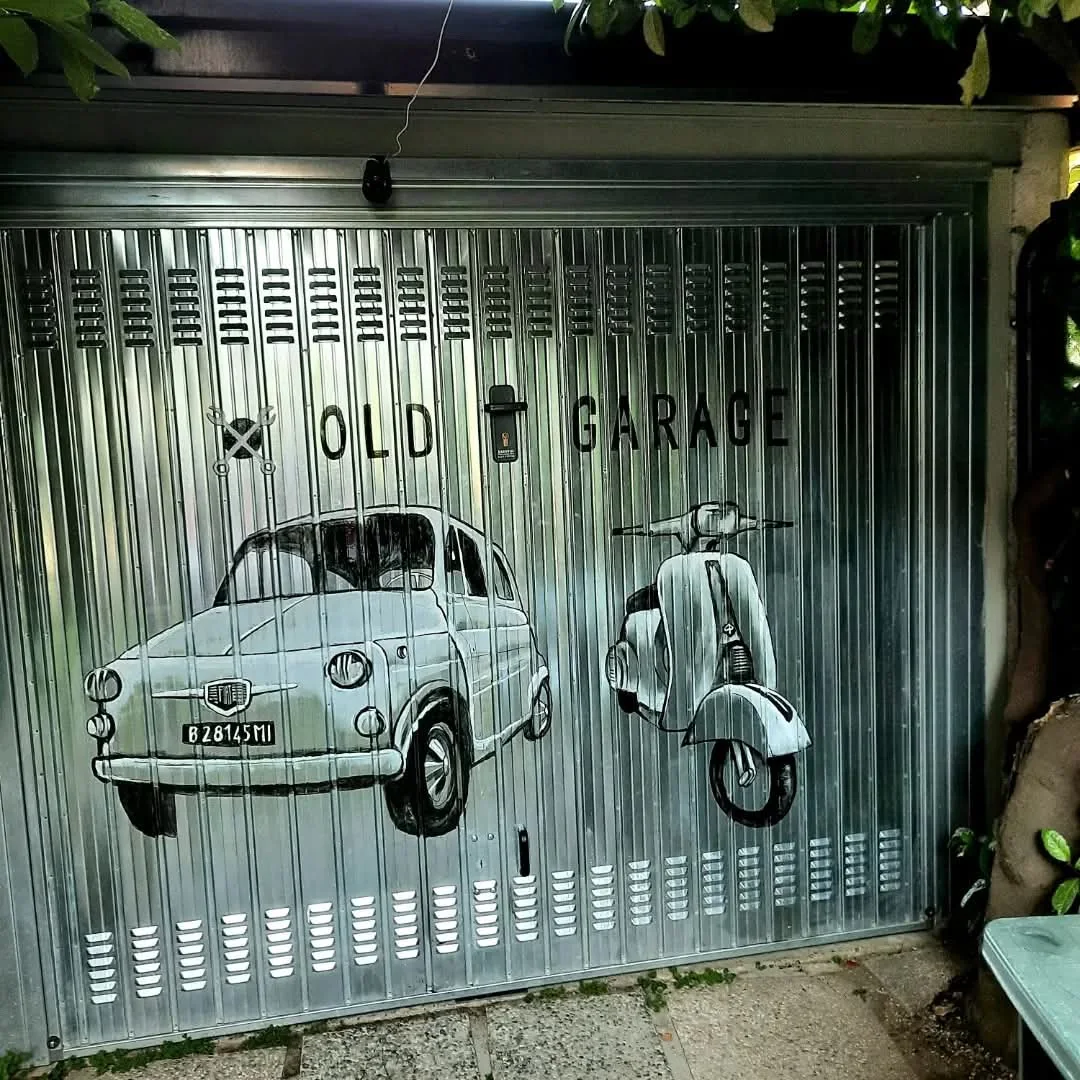
Yes: roller shutters, gates, containers, industrial doors. Metal asks for degreasing and a suitable primer so the paint keys to it, and that preparation is priced in the quote. Once done, a painted shutter works for a shop in the evenings and on Sundays, when it is closed.
Can you paint over wallpaper?
Where the wallpaper is sound and firmly stuck, yes: it is primed and painted over. Where it is lifting or embossed, stripping it first gives a better result and a longer life, and Giulia prices the stripping separately. She says which of the two your wall calls for after seeing a photograph of it.
Can you paint over an existing mural?
Yes. The old painting is primed out with an opaque base, then the new subject goes on top. It is the same process as painting over any wall colour and adds a day or so to the work. Where the existing mural is by another artist, their agreement is the courteous step first.
Does the wall need preparing first?
Sometimes. A sound, dry, clean wall can be painted as it is. Cracks, damp, flaking paint, heavy texture or a very absorbent surface each ask for treatment first. Giulia says what your wall needs from a photograph, and the preparation appears as its own line in the quote, so the price is clear before you confirm.
What if the wall is damp?
The damp is treated first, at its source, and only then is the wall painted. Painting over a damp surface shortens the life of the work, so Giulia checks it before committing to a date. Where the cause is in the building, a builder handles it; where it is surface condensation, a treatment and a sealing coat are enough. The step is itemised in the quote.
What if the wall is cracked?
Fine hairline cracks are filled and sanded before painting, which is part of ordinary preparation. Structural cracks, the kind that keep moving, are dealt with by a builder first, since paint follows whatever the wall does underneath. Giulia says which of the two she can see from a photograph, and prices the filling separately.
Does the wall need to be white first?
A pale, even base gives the truest colour, so Giulia usually applies one where the existing wall is dark or patchy. Where the wall is already light and sound, she paints straight onto it. The base coat is quick and is included in the working days set out in the quote.
How long it lasts
Durability, cleaning, touch-ups, seasons.
How long does a mural last?
Indoors, as long as the wall: an interior mural in odourless acrylic keeps its colour for decades with ordinary care. Outdoors, quartz paint with the right varnish gives many years, and the varnish can be renewed. For scale, Mantegna’s Camera degli Sposi in Mantua, painted between 1465 and 1474, is still there.
Does a mural fade in the sun?
Direct sun is the main thing that ages any pigment. Giulia chooses lightfast colours, and outdoors the varnish carries a UV filter that slows it further. On a south-facing wall the varnish is renewed sooner than on a sheltered one. Indoors, a wall away from full afternoon sun keeps its colour for decades.
How do you clean a mural?
Indoors, a soft dry cloth for dust, and a barely damp one on varnished areas. Outdoors, a garden hose on a gentle setting, or a soft brush with clean water. Pressure washers and abrasive cleaners are the two things to keep away from the surface. Giulia gives cleaning advice for your particular wall when the work is finished.
Can a mural be touched up later?
Yes, and that is one of the advantages of hand painting: the artist who made it can go back to it. A scuff, a knock or a section that has weathered is repainted in place. Giulia keeps a record of the colours she mixed for your wall, so a later touch-up matches. Travel and time are quoted at the point you ask.
What happens if the wall is damaged?
A hand-painted wall is repairable in a way a printed panel is: the damaged patch is filled, primed and repainted, and the join disappears into the picture. Giulia keeps the colour record for your wall so a later repair matches. For a small area she can also send the mixed colours to a local painter with instructions.
Can a mural be removed?
Yes. Indoors, two coats of ordinary opaque wall paint cover an acrylic mural completely, which is what makes a painted wall workable in a rented flat with the landlord’s agreement. Outdoors, the same applies with a masonry paint. It is one of the differences with a wall left bare: paint stays reversible.
Does a mural damage the wall?
A mural sits on the wall the way any wall paint does: it is painted on and can be painted over. It stays light, holds by itself and leaves the plaster as it was. Where the wall was cracked or absorbent, the preparation Giulia does before painting usually leaves it in better condition than she found it.
What is the best season to paint outdoors?
All year round. Quartz paint asks for a dry surface and temperatures comfortably above freezing, so the paint cures properly and the varnish keys to it. Interiors are painted all year round, since the odourless acrylic works in any season.
How long does the work take?
It depends on the surface, the level of detail and the access to the wall. Giulia Dal Bon gives the timing with the quote, within 48 hours, and lets you know well ahead if the calendar moves. While she paints, the room stays in use: the acrylic is odourless.
Does the weather delay outdoor work?
Rain, frost and very high heat each push a facade day back, since the paint needs a dry surface and a workable temperature. Giulia builds a margin into outdoor dates for that reason and warns well ahead when the forecast moves a day. Interiors carry on whatever the weather does.
How long before the paint is dry?
Acrylic is touch dry within an hour and fully cured within a few days. The room comes back into full use the same evening the work finishes. Outdoors, quartz paint needs a dry spell to cure, which is why the season matters. Varnish goes on once the paint underneath has set.
Can furniture go back against the wall straight away?
Give it a day before pushing furniture back tight against a freshly painted wall, so the surface finishes curing with air on it. Everything else in the room can go back the same evening. Giulia sheets the floor and the nearby furniture while she works and clears up at the end of each day.
Does a mural need maintenance?
Indoors, dusting is enough. Outdoors, a gentle rinse once or twice a year and a fresh coat of varnish every few years depending on the exposure. Sea-front and traffic-facing walls need it sooner than sheltered ones. Giulia says what to expect for your particular wall when she hands the work over.
How does a hand-painted mural compare with a printed panel for durability?
A printed panel holds its image until the print itself ages, and then the whole panel is replaced. A hand-painted wall is repaired in place, section by section, and the colours can be matched years later. It is also drawn for your wall, so it runs continuously around corners, switches and sockets.
Does the paint hold up in a bathroom or a kitchen?
Yes, with a varnish over the areas that meet steam, splashes and handling. Giulia paints away from the direct spray of a shower head and seals the surface, which then wipes clean. In kitchens the same applies around the hob and the sink. Ventilating the room after use is what makes it last.
Can a mural be painted on a heated wall?
Yes, on walls with radiators or underfloor-fed heating behind them, provided the surface is dry and the temperature is steady while the paint cures. Where a wall heats and cools sharply, Giulia checks the plaster first. It is one of the details she looks at from the photograph before quoting.
What paint holds up on a coastal wall?
Quartz paint with an anti-salt varnish on top. Salt in the air is the thing that ages a seafront wall fastest, and the varnish is what answers it. Giulia offers it on every coastal wall: the Riviera, Liguria, the Amalfi coast, Sardinia, Sicily, the Greek islands and the Balearics.
What paint holds up on a city facade?
Quartz paint with an anti-pollution varnish, which keeps traffic soot and urban deposits on the surface where a wash removes them. On a street-level wall an anti-graffiti coat can be added as well. Both appear as separate lines in the quote, sent within 48 hours and free.
Murals by place and by city
The other guides
Prices: every answer · Who to hire · Where to paint · Paint and durability · Commissioning · What subject to choose
By type of place
Homes and villas · Children’s rooms · Restaurants and cafés · Hotels and boutiques · Facades and exteriors · Ceilings and staircases · Offices and showrooms
Cities
Paris · Milan · Monaco · Barcelona · Rome · Florence · Murals across Europe · All cities